
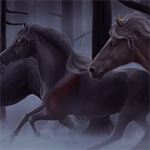

The langoliers were never meant to be a nightmare shared.
The langoliers had been theirs, Gail’s and Carnage’s. the symphony to the end of the world. She’d followed him to see how the world ended, had gone with him when he’d asked. And he’d wanted to, too. She believed it then and she does now. In the moment, he had wanted to see the world end.
But something had changed. His thoughts had shifted, some Other’s magic had crept out, snatched him back and left her in stasis.
She doesn’t think of it, often. She had lifetimes to wonder at the way the world ended as the hours set and re-set themselves. Lifetimes to wonder if Carnage had left her there by accident, or on purpose.
In dreams, of course, she does think of it. In dreams there is nothing but the sound, the black sand squelching at her legs.
Death does not terrify her (she’d died once already, and spent a century waiting for the world to end), but the langoliers do. The nothingness they had promised had been somehow more terrifying than death, in a way she cannot entirely articulate.
She hadn’t wanted Carnage to send others, to subject them to the nightmare, to the noise, to the blankness of a world ending. It was not their lot.
Worse, she is scared to see them returned. Scared they will die, that they will be unable to stand what Carnage put upon them (he told her pieces, and she filled in gaps, and the stories are nothing short of horrifying).
Ramiel alleviates it, for the moment. He is not dead. Not in the ways she’d feared, at least. She exhales a breath of relief. Foolish, because she doesn’t need to breathe, but it’s a habit she still finds herself with.
“I’m glad,” she says, “I worry about all of you.”
***
“What are you?” Graveling asks. She pays no attention to Gail’s soft tones, to the concerns and reliefs playing across her dark face. Graveling is far more interested in the stranger, the intruder, who seems that he should belong, but doesn’t. Who even says he isn’t dead!
(Ridiculous. They’re all dead, here.)
***
“Ramiel,” she says, pauses. She regards him. She can see, even in his ghost-form, that he is grown. He is handsome. In another world, she might have grown to love him (he reminds her a bit of Mryddin, the same kindness, the same strength). None of that matters now, of course.
“Graveling is…different,” she manages, “she doesn’t realize it because she’s only been around the dead.”
Graveling snorts, looks at her. She doesn’t roll her eyes, but it’s close. It’s a terribly childlike gesture from a girl who’s existed in limbo far too long, and for a selfish moment Gail wants to say nothing, to keep her here, raise her as her own.
“I think she can go back.”
.
graveling
the worms crawl in, the worms crawl out